
In Part I we learned that advocacy in the “rights-based” Court Model is hard on the people involved because by focusing on the 3
rd-party decision maker, e.g., the judge, the parties care little about each other’s view. As a result, their relationship can become more adversarial. In Part II we learned that by removing the decision maker in the “interest-based” Collaborative Model the parties become the decision makers who resolve mutual problems based on their defined future needs, interests, and goals. But is the removal of the 3
rd party decision maker enough to create a process that is truly “soft” on the people?
Most people who have gone through a divorce agree that divorce is much more than a legal event. More importantly divorce is about changing relationships, improving communication, establishing co-parenting, engaging in problem-solving, and securing a stable financial future. But many divorce processes do not adequately address these more important concerns, thus limiting divorce to simply a legal commodity.
To gain the
added value of improving your relationship with your soon-to-be ex-spouse, of becoming successful co-parents, of mutually planning for the future, and of customizing your financial arrangement to meet the needs of all family members within the resources available, requires the assistance and expertise of NEUTRAL professionals. These neutral professionals include a Neutral Financial Professional, a Neutral Coach, and a Neutral Child Specialist. This team approach is the “secret sauce” used in the Collaborative Model that can transform the experience of this life event into something constructive, affirming, and even peaceful. Obviously, this is of great benefit to children.
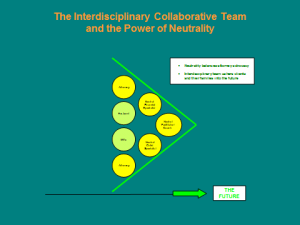
In addition to the support and expertise provided, the neutrality of the neutral professionals balances attorney advocacy. This permits the attorney to stay in the problem-solving and interest-based advocacy role for his or her client, while the neutral professionals hold the ground for resolution on behalf of the whole family. This interdisciplinary, holistic approach to advocacy and expertise is what distinguishes the Collaborative Model from any other model out there.
Collaborative professionals like to say this model contributes to world peace one family at a time. If this approach makes sense to you, tell your friends, family, and colleagues about the Collaborative Model and contribute to world peace.


 The longer I work as a neutral child specialist, the more important I realize it is to help divorcing parents have meaningful conversations about the possibility that one or both of them will enter into new significant relationships while their children are growing up. New significant relationships usually generate a range of emotions and reactions in all family members, some of which are unanticipated. It’s not uncommon for families to re-engage with me when a parent remarries or re-partners to help ensure that children’s best interests are kept at the center of a new family dynamic.
New relationships introduce another element of change and uncertainty into co-parenting. Parenting arrangements for the holidays that were working well may suddenly be called into question. Boundaries may need new clarification, e.g. who is welcome to attend parent-teacher conferences or take children to their swim meets. Advance planning and discussions that normalize potential co-parenting road bumps can help parents stay centered on what’s best for their children.
Here are five basic considerations regarding new significant relationships:
The longer I work as a neutral child specialist, the more important I realize it is to help divorcing parents have meaningful conversations about the possibility that one or both of them will enter into new significant relationships while their children are growing up. New significant relationships usually generate a range of emotions and reactions in all family members, some of which are unanticipated. It’s not uncommon for families to re-engage with me when a parent remarries or re-partners to help ensure that children’s best interests are kept at the center of a new family dynamic.
New relationships introduce another element of change and uncertainty into co-parenting. Parenting arrangements for the holidays that were working well may suddenly be called into question. Boundaries may need new clarification, e.g. who is welcome to attend parent-teacher conferences or take children to their swim meets. Advance planning and discussions that normalize potential co-parenting road bumps can help parents stay centered on what’s best for their children.
Here are five basic considerations regarding new significant relationships:





 Divorce is a crisis in the life of a family. It is not actually a legal crisis, though it requires this expertise to ensure that legal resolutions are reached regarding financial matters. It is not a theoretical crisis. It is a genuine emotional crisis. What does this mean for children?
Some years after I began my therapy practice with children and families decades ago, a researcher named Judith Wallerstein published the results of her longitudinal study on the negative impact of divorce on children. The data were a wake-up call, shocking to some, sobering to all. Mental health experts responded by saying parents and social institutions needed to be more attentive to the impact of divorce on children. A book was written advocating bird nesting—parents rather than children transitioning to and from the homestead—as an alternative “custody” arrangement for families (an option we now know to be a temporary rather than permanent solution). Questions began to be raised on the impact of parenting time arrangements that essentially minimized otherwise healthy and loving relationships between parents and children.
At the time Wallerstein’s study was published, the options available for divorcing parents were largely adversarial in nature. The focus was “rights based,” not based on supporting co-parenting and keeping children out of the middle of the crisis. Many of the parents with whom I work attest to the emotional trauma they experienced when their own parents divorced. In fact, it is likely these divorcing parents were assured by their attorneys that “children are resilient—your kids will be fine.” But we know that children do not become resilient in a vacuum. They need adults to create environments of support and attention to their needs.
Collaborative team divorce offers a clear and powerful alternative for parents who love their children and want to envision a hopeful future for them. Families work with a multidisciplinary team of professionals with specific skills and experience. Mental health expertise is woven throughout the process, both to specifically support children and to provide parents with the best possible grounding for effective co-parenting. If you want to know more about how your family can weather the emotional crisis of divorce with the most dignity and respect for the needs of your children, please learn more about Collaborative team practice at this link to the website for the
Divorce is a crisis in the life of a family. It is not actually a legal crisis, though it requires this expertise to ensure that legal resolutions are reached regarding financial matters. It is not a theoretical crisis. It is a genuine emotional crisis. What does this mean for children?
Some years after I began my therapy practice with children and families decades ago, a researcher named Judith Wallerstein published the results of her longitudinal study on the negative impact of divorce on children. The data were a wake-up call, shocking to some, sobering to all. Mental health experts responded by saying parents and social institutions needed to be more attentive to the impact of divorce on children. A book was written advocating bird nesting—parents rather than children transitioning to and from the homestead—as an alternative “custody” arrangement for families (an option we now know to be a temporary rather than permanent solution). Questions began to be raised on the impact of parenting time arrangements that essentially minimized otherwise healthy and loving relationships between parents and children.
At the time Wallerstein’s study was published, the options available for divorcing parents were largely adversarial in nature. The focus was “rights based,” not based on supporting co-parenting and keeping children out of the middle of the crisis. Many of the parents with whom I work attest to the emotional trauma they experienced when their own parents divorced. In fact, it is likely these divorcing parents were assured by their attorneys that “children are resilient—your kids will be fine.” But we know that children do not become resilient in a vacuum. They need adults to create environments of support and attention to their needs.
Collaborative team divorce offers a clear and powerful alternative for parents who love their children and want to envision a hopeful future for them. Families work with a multidisciplinary team of professionals with specific skills and experience. Mental health expertise is woven throughout the process, both to specifically support children and to provide parents with the best possible grounding for effective co-parenting. If you want to know more about how your family can weather the emotional crisis of divorce with the most dignity and respect for the needs of your children, please learn more about Collaborative team practice at this link to the website for the 

 Divorcing parents often wonder how vacations are treated in a parenting plan. There are often three types of vacation options addressed in divorce.