
82830939In Part I we learned that “rights-based” advocacy in the Court Model is hard on the problem but also hard on the people. Advocacy in the “interest-based” Collaborative Model is also hard on the problem, but SOFT on the people. How is this possible? In the Collaborative Model, the parties voluntarily agree to reach a settlement outside of court. Thus the 3rd party decision-maker, e.g., the judge, is removed from the collaborative process. Instead, the decision-maker is the parties themselves!
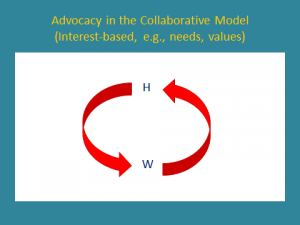
Circle Diagram for Collab Model 082814

In order to reach a settlement, the parties must consider and honor the other party’s perspective. In the Collaborative Model, advocacy is not about the position a client takes on a particular issue, but about meeting the future needs, interests, and goals that are defined by the couple themselves. By framing the problem in terms of needs, interests and goals, parties are likely to see their dispute as a mutual problem that they must work together to solve. They now answer the question: how do we both get our needs and interests met? How does our family get its needs and interests met? Advocacy in the Collaborative Model encourages parties to look behind their opposed positions to determine the motivating interests. In doing so, the parties often find alternative solutions that meet the needs of both sides. Collaborative advocacy pays attention to balance, listening and being creative. Collaborative advocacy creates an incentive to work together, acknowledge the other, to be authentic and realistic. This kind of collaboration can occur only in an atmosphere that is respectful, transparent, and mutual; and one that incentivizes caring about the other party’s point of view with the removal of the 3rd party decision-maker. While being hard on the problem and soft on the people seems to be a contradiction, it is this contradiction that promotes better settlements and preserves needed relationships. Who knew that removing the 3rd party decision-maker could make such a difference! In Part III, I will explore how the power of neutrality is the secret sauce to a successful collaborative divorce.

It may be hard to believe, but 2014 is two-thirds of the way over. Did you set a new year’s goal that you have long forgotten about? Now is as good of time as any to set a new goal and hold yourself accountable. With the kids going back to school maybe you will be getting up extra early anyhow or have time after you drop them off at the bus stop to get a quick workout in? With schedules changing, now is the time to add a new health and fitness goal into your routine. With cooler temperatures and the leaves changing colors, fall is the perfect season to take up exercising outdoors. Taking on a physical challenge, like running, after divorce is very common. It may be the desire to be in better shape, desire to prove to yourself that you can accomplish a goal, or maybe it’s just to pass the extra time you may now have, especially if you have children that are now being “shared.” Getting started in walking, running, or joining a gym not only boosts confidence, but it is also a great way to meet new friends. Do you need another great reason to start working out post-divorce? It’s a proven stress reliever, something everyone can benefit from. Many fun fall runs around the Twin Cities have caught our eye recently – the Glo Run, Hot Chocolate run, Monster Dash, and turkey trots, oh my! Grab a friend, sign up together, and have fun doing it! You don’t have to be fast, it’s all about goal settling and doing something for YOU!
140196937Parties going through a divorce need to understand that advocacy in the “rights-based” Court Model and advocacy in the “interest-based” Collaborative Model are different; and advocacy in each of these models feels different as well.  Bear with me while I examine Advocacy in the “rights-based” Court Model in Part I in preparation for discussing advocacy in the “interest-based” Collaborative Model in Part II followed by the “power of neutrality” in Part III.   Trust me, this is interesting. In a rights-based model, “rights” are independent standards of fairness or legitimacy that are formally established in law or contract.  Usually different rights or entitlements are at stake in a particular case.  Here, each party and their attorney is playing to the decision-maker, e.g., the judge, or playing to a prediction of what the decision-maker would decide based on application of the law to the facts of the case.

Diagram - Advocacy in Rights-based Model 082814

In this case, neither party cares much about the other party’s point of view.  What matters is what the judge thinks or is predicted to think.  “Rights-based” advocacy focuses on winning and losing and defending positions, and frequently emphasizes past events.  The relationship between the parties is likely to become more adversarial, the parties becoming opponents interacting in an accusatory atmosphere.  While advocacy in this model is hard on the problem, it is also hard on the parties. A rights-based model can sometimes accomplish what an interest-based model cannot—bring an end to the divorce.  There will always be parties and problems that cannot be resolved without a 3rd party decision-maker making a final decision or threatening to make a final decision for the parties.  But for many families, a rights-based procedure is not necessary.   A rights-based procedure should be a last resort rather than a first resort. That was pretty interesting, right?  In Part II, I will examine advocacy in the “interest-based” Collaborative Model and how the removal of the 3rd party decision-maker makes all the difference.  In Part III, the power of neutrality is shown to be the secret ingredient to advocacy in the “interest-based” Collaborative Model.
177884875The kids might not be the only ones headed back to school this fall. Divorce forces many parents back into the workforce, and for some, even back to school. Divorce can initiate some dramatic changes in your lifestyle, and it make you re-evaluate yourself and your career. Some former stay at home parents are now looking for an enriching way to increase earning potential by going back for a degree they never finished, for a new degree, or for some it may be their first time in college. Divorce forces many people to take a risk, to do something for their selves, to strive for personal growth and to set goals, which is why many decide going back to school is a good option for them. When evaluating if going back to school is the right option for you consider that your goals are: Are you hoping to begin a new career? Advance in your current career? How long will it take? What will you be able to earn when you are finished? Consider the cost: Ask your attorney about whether continuing your education post-divorce will affect your spousal maintenance. Check with your employer to see if they cover any of the cost. Discuss your financial situation at the college’s Financial Aid office to see if you may qualify for any grants or scholarships, and of course, compare tuition amounts for schools in your area. Typically called, “non-traditional students” divorcees, over 35, and typically women, make up a good percentage for the student population at community, private, and online colleges, which usually offer flexible schedules and work at your own pace credit loads to graduate. It is not easy taking a risk and making a big commitment to go back to school, but if you decide that going back to school post-divorce is for you, rest assured that you are not alone.
464714163Peace is possible though we are surrounded by high conflict. In the recent words of former Secretary of State Madeleine Albright, “The world is a mess.”  Messiness occurs when people are unable or unwilling to resolve differences without wars of words or weapons.  This occurs not only globally but also on a personal scale.  And for all the extraordinary human costs of violent conflict, the most deeply distressing is its impact on children. The end of a marriage is not unlike the breaking up of a country based on sectarian differences.  Is it possible to disconnect without civil war?  Yes, but one must be mindful of the path one is choosing, and deliberately opt to not do battle.  Though sometimes complicated, peaceful resolutions are possible if the focus remains the safety and wellbeing of children. I do not believe conflict is inevitable, because for every cause of conflict there is an inverse possibility.  In our day-to-day lives, we can choose a path of peace.  We can elect to follow The Four Agreements as defined by Don Miguel Ruiz in his book by the same name, and use these principles to help us resolve our differences:

  1. I will be impeccable with my word.
  2. I will not personalize what the other person says, does, thinks or believes.
  3. I will make no assumptions.
  4. I will do my best every day with the energy I have been given.
In Collaborative Team Practice, parents who are getting unmarried can draw from sources of support for the emotional, financial, parenting and legal issues that are involved.  Parents remain in charge of their own outcomes, but are given tools to keep the process as respectful as possible, thereby setting the stage for child-centered co-parenting.  The world your children will inhabit is in the future.  May it be a peaceful one.
182021502The Collaborative divorce process is one of many ways to divorce. It’s not for everyone. So how do you know whether it is right for you and your spouse or partner? Here are a few questions to help you decide:
  • Do you want your children to be in the center rather than in the middle?
  • Do you want your lawyer to be a wise counselor rather than a hired gun?
  • Are you willing to be in the same room with your spouse or partner?
  • Are you able to speak for yourself and articulate your own goals and interests?
  • Are you open to solutions that respect both your and your spouse’s interests?
  • Do you want to focus on future solutions rather than past disagreements?
  • Do you want a comfortable co-parenting relationship with your former spouse?
  • Are you willing to experience and live with some discomfort at times during your divorce?
  • Do you want solutions that take into consideration the uniqueness of your family?
  • Do you want to model healthy dispute resolution for your children, friends and family?
  • Do you want to be able to look back on your divorce and feel good about both the outcome and how you handled yourself during the process?
If you answered “no” to any of these questions, another, more traditional divorce process may be a better choice for you. Collaborative divorce is best-suited for couples who understand the value of divorcing well. How you divorce greatly impacts your children’s well-being and your own ability to move forward in life without resentment. If you answered “yes” to these questions, the Collaborative divorce process may be a good choice for you. To find out more, go to www.collaborativelaw.org and contact a Collaborative professional.
My daughter Sarah with her grandmothers
Perhaps the most important advice I can give someone going through a divorce is to keep the long view in mind. Although it is easy to be swamped by the immediate emotions, the years after the divorce are where you see the impact of your decisions on your entire family. And nothing brings it to the forefront like a milestone event for your child, which I am currently experiencing. My daughter Sarah graduated from high school and will soon be heading off to Wellesley College. This summer has been marked by a graduation weekend with extended family, and soon I will join my fiancé and Sarah’s dad to move Sarah into her dorm. Bringing together the extended family for graduation post-divorce could have been painful and awkward. But it was a wonderful, celebratory weekend filled with love for Sarah and our love and respect for all members of the family. Sarah was in grade school when her dad, John, and I divorced. Divorce is always painful, but we were blessed with a team of collaborative professionals to assist us in the process. I have known for years that a collaborative divorce launched our excellent co-parenting relationship. What really resonated on graduation weekend was the impact on the extended family. My mom flew in from Arizona and John’s mom flew in from New York. These grandmothers had not seen each other since Sarah’s baptism. John’s brother came from Pennsylvania, and he had not seen my mom since our wedding 24 years ago. Also in the mix was my fiancé, Josh, his daughter Lily and his parents. I admit I was a bit nervous about seeing my former mother-in-law and brother-in-law, but it was incredible. We all worked together setting up for Sarah’s graduation party, had multiple meals together, carpooled to the ceremony and sat together cheering for Sarah as she collected her diploma. The love was abundant in all these events, which was priceless. Here’s what collaborative practice allowed for our family: we began to forgive each other and start healing. If we had litigated, the resentments would have become entrenched. By forgiving each other for our failures in the marriage, we could open up to respect and even love towards each other as parents of our amazing daughter. Our tone set the tone for our families – no one needs to choose sides or hold resentments. We can celebrate with full hearts. When we wave goodbye to Sarah at Wellesley this month, she can feel secure knowing her crazy, blended family is behind her, laughing, hugging and linking arms. I am looking forward to the next milestone, when we can all gather again. I know that wouldn’t be possible if we had litigated our divorce. I hope every parent going through a divorce strives for more than just being civil to each other. My hope is that you can celebrate the gifts each parent and family member brings to the life of your child. It starts with your divorce process – collaborative practice allows you to transform your relationship.
I received a text message the other day from a friend asking if I heard that mutual friends of ours had filed for divorce. I was not surprised to receive this news as it was a long time coming, however, I was surprised that the driving point of the text was how “ugly” the divorce was going to get. With three little girls between the ages of 6 and 12, ugly is the last thing they need. The exchange made me recall an email that we received at Daisy Camp a few months ago. The women had used one of the best divorce attorneys in the Twin Cities and had been out for blood. It look her five years post-divorce to realize that she wanted to “get better, not bitter,” and that the payback that she was seeking in her divorce would never take away the broken heart or help her to heal. 5 years later she realized that no divorce concessions would have justified as payback, but what she was actually seeking was healing. It is easy to get caught up in the heat of the divorce and not realize that the amount of money, division of property, child support, spousal maintenance (alimony), or the amount of child custody time that is “won” won’t mean a thing if it come at the cost of the relationship if your children. Which is why more and more couples are seeking to divorce collaboratively these days. No one wins in divorce, but you have a lot to lose when a divorce gets ugly.
170954936Not all divorces are related to alcohol abuse, but the percentage is fairly high.  I don’t have any scientific study, but my own experience of observing thousands of divorces over three decades, I have found that nearly half of all divorces involve, at minimum, allegations of some type of alcohol abuse.  From observing the interactions in these cases, as well as working with professionals in these areas, here are the most important observations I have made: If you think there is a problem, you are probably right. If one party truly believes there is alcohol abuse in the marriage, there is a very high probability that they are right. Yes, it is true that divorce can lead to many false allegations, particularly if you are in an adversarial divorce.  However, while divorcing couples often exaggerate most flaws of the other spouse, I have found that, largely because of co-dependency dynamics, many spouses actually under report alcohol abuse. If your spouse thinks you have a problem, you certainly have a problem. How can I be certain?  Easy.  First, as indicated above, if your spouse truly thinks you have a problem, there is a high probably they are right.  Moreover, even if they are wrong, their belief that you have a problem is, by itself, a major problem.  In either case, the solution often points to undergoing a thorough and honest alcohol assessment. If you can get at the truth, everyone wins. A spouse stopping or cutting back alcohol use during the divorce proves little.  Often the spouse believed to have an alcohol problem will either stop using alcohol or cut back on alcohol use as the threat of divorce draws near.  While this may (or may not) be a welcome reprieve for the family, it generally means very little in terms of determining the existence of a problem.  Indeed, most chemical dependency counselors see frequent failed attempts to stop or cut back as being one of the indicators of alcoholism.  Moreover, for most alcoholics, stopping drinking does not necessarily end the alcoholic behavior. Sometimes alcohol use during divorce can be “situational”. Divorce usually does not come up suddenly, but rather creeps into homes over months or years.  As it creeps closer, the sadness or fear can sometimes cause non-alcoholics to temporarily abuse alcohol during this difficult time. While temporary abuse of alcohol still has serious consequences the long-term impact can be quite different than addressing alcoholism. If alcohol is an issue, you need a process in which honesty can be rewarded.  Divorce processes differ.  Traditional divorces that operate in the shadow of the courthouse can sometimes seem to punish honesty in the sense that the person suspected of alcohol abuse feels compelled to either deny or minimize the allegations for fear of losing time with their children.  On the other hand, processes such as Collaborative Law or mediation, by operating outside of court, can provide a safe place where alcohol use can be addressed as a health issue and not as a piece of evidence.  To learn more about these options go to www.Collaborativelaw.org or www.divorcechoice.com.

158812369Divorce is a family event that impacts children of all ages.There has been an uptick of divorces for middle-aged and older couples whose children may have already launched their adult lives.Just because children are not living under the same roof with a parent or parents does not mean their lives won’t be deeply affected by family changes that will occur following a divorce.

At Daisy Camp, I have heard many sad stories of communication breakdowns between parents and their adult children during and after a divorce.Adult children experience unique emotional distress and practical challenges. Regardless of age, children can feel caught in the middle if parents remain in conflict.In fact, adult children can experience a heightened sense of betrayal and confusion about what has happened to their family of origin

Here are three considerations for divorcing parents of adult children:

1.  It is helpful for adult children if parents are able to inform them about the divorce with a thoughtfully prepared joint We Statement.This allows parents to be more in charge of the message and the tone, and may gently discourage adult children from feeling as though they are expected to take sides or determine who is to blame.A Neutral Child Specialist can assist parents in the creation of a We Statement.

 2.  Adult children will continue to have personal and family-centered milestones to celebrate, including graduations, engagements, marriages and births of grandchildren.   Advance planning and clear communication with adult children about parents’ readiness and willingness to jointly participate can reduce anxiety for adult children.If parents are not ready and willing to jointly participate, being able to constructively problem solve with children so the events can proceed without undue drama is also helpful to them.A worst-case scenario for adult children is feeling helplessly caught in a power struggle between parents for every family event.

 3.  Adult children may ask difficult questions, and parents need to be prepared to answer honestly but without making their children feel the necessity of taking sides.Keeping children at the center and out of the middle can be especially challenging if there has been an infidelity or other breach of trust in the marriage.Under these circumstances, it can be especially valuable for divorcing parents to get the support and guidance of a neutral mental health professional.

 Collaborative Team Practice provides access to skilled mental health expertise from a Neutral Child Specialist or Neutral Coach to guide parents to support their adult children through a difficult transition that will impact the rest of their lives.It is a privilege to help parents create a legacy of healing and respect for their adult children and grandchildren.