
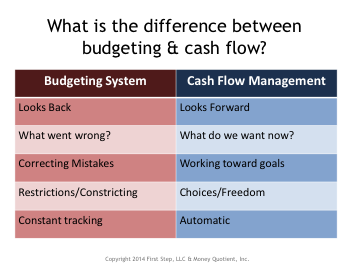
I teach a cash flow planning course throughout the metro area. One of the ways I begin, is by asking everyone to tell me the first word that comes to mind when they hear the word budget? Often it is a negative type of word like restricting, confining, or boring. When I ask a similar question about cash flow, common responses are future and choice. The chart below illustrates some of those differences.
Money is one of those issues often cited as a reason for divorce. I would offer that money itself does not cause divorce. How spouses handle money differently and an inability to recognize their different money personalities and learn effective ways to work through those differences can lead to divorce or at least cause significant strain in a marriage.
Establishing reasonable and necessary future living expenses post-divorce is one of the two pillars of any
divorce process. Both spouses will need to establish their own living expenses independently of one another. If money was a source of conflict in the marriage, imagine the conflict that exists during the divorce process. The reality is the money conflict can and often does escalate in divorce. In my work as a
financial neutral, financial mediator, and financial planner, I work with you and your spouse to help you focus on your future.
One approach to creating a future oriented cash flow plan for your post-divorce life is to add up all of your expenses necessary for your basic living needs. This would include things like housing, food, clothing, and medical care to name a few. If you are familiar with Maslow’s hierarchy of needs, this would be the lower level (safety and security) in the hierarchy. Keep in mind that at this basic level food does not include dining out. Clothing does not include upscale designer clothing. Items in this safety and security level are for basic needs.
After taking care of basic needs you can then address expenses that you have total control and choice over such as dining out, entertainment, cash spending money, gifts, personal care, etc.
Finally, you may want to consider future goals and needs like retirement, creating an emergency savings plan, a different automobile, or an education.
Think of separating these expenses into three different categories. I ask my clients to visualize these as three distinct buckets. The buckets are one for basic needs, two control and choices, and three future needs and wants. It is important to recognize that during and after the divorce, you may need to at least temporarily forgo some if not all of the future needs and wants, and substantially minimize the control and choice buckets due to the initial financial strain of divorce.
It is equally important to recognize this time-period does not necessarily last forever. Incomes can and do increase over time and some expenses such as child-care reduce and ultimately disappear at some point.
A well-developed future oriented cash flow plan can give you the peace of mind to know you will be financially secure. It can give you the opportunity to choose what is important to you about money, prioritize your goals, and create a solid model and roadmap for your life ahead. A financial neutral in
collaborative divorce process will help you create this type of plan.
A short three-minute video on the history of cash flow and money management is available by clicking
here.


 Almost all divorces end up in a negotiated settlement. (In most states, less than 5% of all divorces actually go to trial.) Therefore, the most important thing for couples to consider, before they start down the path toward divorce, is how to negotiate the best possible resolution to your divorce.
When I ask most clients what they want from a divorce process, they almost always talk about two things:
1.) They want a divorce that is amicable.
This makes sense. Most wise people would want an amicable divorce; either for the sake of their children, the protection of their finances, preserving their own mental health, or all three. No sane person would choose to have a messy divorce if they can avoid it.
2.) They want to feel protected.
At the same time, almost everyone wants to feel some sense of protection. They are entering into important agreements that will impact their lives and, perhaps, the lives of the children for many years. They do not want to sign an agreement that they will resent or regret.
These two negotiating goals do not need to conflict with each other.
The biggest mistake that people can make is thinking that these two goals are in conflict with each other. They want an amicable divorce but they think the need to hire an aggressive lawyer to protect their needs. Or, alternatively, they think that all lawyers will be aggressive so they avoid getting legal counsel and end up with a settlement that they regret.
Contrary to common belief, it is possible for divorcing clients to have the “best of both worlds”. This is the very reason that Collaborative Practice has grown all over the world.
The best scenario, of course, would be to have an attorney who will protect your interests and yet preserve an amicable environment. Collaborative Attorneys are trained in non-adversarial negotiating strategies and they are retained for settlement purposes only. Because they focus on settlement only, they work to help your spouse to “say yes” by using interest based methods that help you get better outcomes, without creating the rancor and expense of using adversarial methods.
To learn more about Collaborative Practice, and how it can be used to help you get your best outcomes, go to www.collaborativelaw.org or www.divorcechoice.com.
Almost all divorces end up in a negotiated settlement. (In most states, less than 5% of all divorces actually go to trial.) Therefore, the most important thing for couples to consider, before they start down the path toward divorce, is how to negotiate the best possible resolution to your divorce.
When I ask most clients what they want from a divorce process, they almost always talk about two things:
1.) They want a divorce that is amicable.
This makes sense. Most wise people would want an amicable divorce; either for the sake of their children, the protection of their finances, preserving their own mental health, or all three. No sane person would choose to have a messy divorce if they can avoid it.
2.) They want to feel protected.
At the same time, almost everyone wants to feel some sense of protection. They are entering into important agreements that will impact their lives and, perhaps, the lives of the children for many years. They do not want to sign an agreement that they will resent or regret.
These two negotiating goals do not need to conflict with each other.
The biggest mistake that people can make is thinking that these two goals are in conflict with each other. They want an amicable divorce but they think the need to hire an aggressive lawyer to protect their needs. Or, alternatively, they think that all lawyers will be aggressive so they avoid getting legal counsel and end up with a settlement that they regret.
Contrary to common belief, it is possible for divorcing clients to have the “best of both worlds”. This is the very reason that Collaborative Practice has grown all over the world.
The best scenario, of course, would be to have an attorney who will protect your interests and yet preserve an amicable environment. Collaborative Attorneys are trained in non-adversarial negotiating strategies and they are retained for settlement purposes only. Because they focus on settlement only, they work to help your spouse to “say yes” by using interest based methods that help you get better outcomes, without creating the rancor and expense of using adversarial methods.
To learn more about Collaborative Practice, and how it can be used to help you get your best outcomes, go to www.collaborativelaw.org or www.divorcechoice.com. 






 I sat in on a seminar recently with a room full of moms. Moms of babies, moms of toddlers, moms with children just starting elementary school. The topic was about learning to fall in love with your husband again, and the speaker was a woman in her 70’s. The dialog was mainly, “Do this to keep your husband happy, do that to keep your husband happy…” I think many were wondering why they got up early on a Tuesday morning to listen to old-fashion marriage advice. However, in between the eye rolls of many overtired moms, I caught the true message of the speech – don’t forget about your marriage, the kids are wonderful, but if you make them your whole world, they leave the nest, and the marriage is over.
I had not really thought about empty nest syndrome in this sense. I had mainly thought about the kids going off to college and the parents are alone in a big empty house, they are a little lonely, maybe start a new hobby, and life goes on. Only life doesn’t go on, at least not in that sense. Divorce after decades, the graying divorce, divorce after 50, whatever you may call it, is becoming more and more common. Decades of putting the kids first, likely putting the career second, and well, the marriage must have fallen down on the priority list.
When children are babies and toddlers they require about every last bit of energy you have; once they start school it’s homework, sports, and juggling schedules. Making it all too easy for the better part of 20+ years for your marriage to be entirely kid-centric. The graying divorce gives new meaning to staying together for the kids. The couple in many of these marriages might not have even seen it coming. Years of enjoying the children together – family vacations, neighborhood outings, cheering the kids on together from the sidelines, only to wake up one day and realize they no longer have anything in common, the kids were all they had in common.
A half-century ago, only 2.8 percent of Americans older than 50 were divorced. In 2011, according to the Census Bureau’s American Community Survey, 15.4 percent were divorced and another 2.1 percent were separated. Was it that divorce was more taboo 50 years ago, or maybe because people are living longer these days? A healthy 60 year old might look at it in terms of having 20+ years left; 20+ years that they are choosing to be happy, and ditching the unhappy marriage. Baby boomers are setting record high divorce numbers.
If you found yourself amongst this new era of divorce, the good news is you are in good company! There are support groups nationwide that are catering specifically to the increase in baby boomers and their graying divorces. Seek out divorcees going through a similar situation and create a support system. Most importantly, keep on living – enjoying yourself, pursue your interests, take on a new hobby, travel, and make the most of your new-found free time!
I sat in on a seminar recently with a room full of moms. Moms of babies, moms of toddlers, moms with children just starting elementary school. The topic was about learning to fall in love with your husband again, and the speaker was a woman in her 70’s. The dialog was mainly, “Do this to keep your husband happy, do that to keep your husband happy…” I think many were wondering why they got up early on a Tuesday morning to listen to old-fashion marriage advice. However, in between the eye rolls of many overtired moms, I caught the true message of the speech – don’t forget about your marriage, the kids are wonderful, but if you make them your whole world, they leave the nest, and the marriage is over.
I had not really thought about empty nest syndrome in this sense. I had mainly thought about the kids going off to college and the parents are alone in a big empty house, they are a little lonely, maybe start a new hobby, and life goes on. Only life doesn’t go on, at least not in that sense. Divorce after decades, the graying divorce, divorce after 50, whatever you may call it, is becoming more and more common. Decades of putting the kids first, likely putting the career second, and well, the marriage must have fallen down on the priority list.
When children are babies and toddlers they require about every last bit of energy you have; once they start school it’s homework, sports, and juggling schedules. Making it all too easy for the better part of 20+ years for your marriage to be entirely kid-centric. The graying divorce gives new meaning to staying together for the kids. The couple in many of these marriages might not have even seen it coming. Years of enjoying the children together – family vacations, neighborhood outings, cheering the kids on together from the sidelines, only to wake up one day and realize they no longer have anything in common, the kids were all they had in common.
A half-century ago, only 2.8 percent of Americans older than 50 were divorced. In 2011, according to the Census Bureau’s American Community Survey, 15.4 percent were divorced and another 2.1 percent were separated. Was it that divorce was more taboo 50 years ago, or maybe because people are living longer these days? A healthy 60 year old might look at it in terms of having 20+ years left; 20+ years that they are choosing to be happy, and ditching the unhappy marriage. Baby boomers are setting record high divorce numbers.
If you found yourself amongst this new era of divorce, the good news is you are in good company! There are support groups nationwide that are catering specifically to the increase in baby boomers and their graying divorces. Seek out divorcees going through a similar situation and create a support system. Most importantly, keep on living – enjoying yourself, pursue your interests, take on a new hobby, travel, and make the most of your new-found free time!