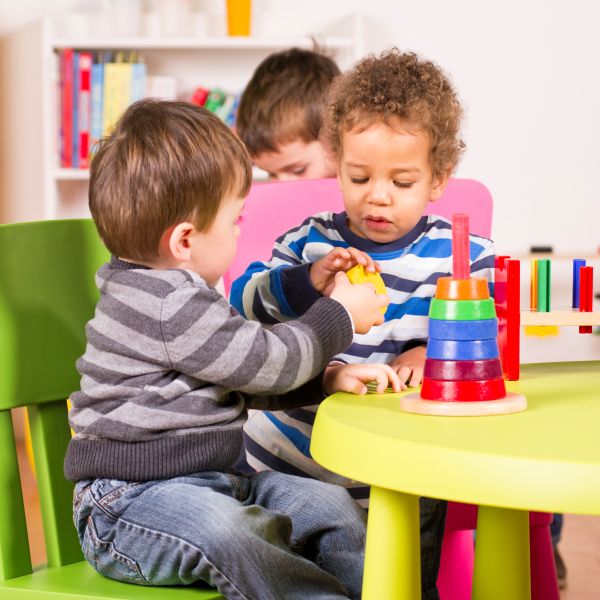
In Part 1, we discussed how children seem to know how to play, yet they develop important skills through play. In Part 2, we identified and explored the seven skills children develop through play. As a refresher, those skills are:
- Creative thinking – to consider and experiment with alternatives freely and without fear in any situation.
- Critical thinking – to discern knowledge, information, and interest in order to solve a problem, prove a point, or decide what to believe.
- (Self)-Control – to interface with and within a bustling society with the ability to manage one’s own attention, emotions, and behaviors.
- Confidence– to genuinely believe in one’s own abilities to experience success and satisfaction in not only what one can do, but also what one is willing to try.
- Collaboration – to engage with others positively and productively in pursuit of a common goal.
- Communication – to take language and literacy (the tools of communication) and use them to exchange information with power and precision.
- Coordination – to recognize, use, and appreciate the physical marvels of the human body.
Now, we are going to dive a bit deeper into the 5th skill mentioned above: Collaboration. Since we are talking about Collaborative Divorce, let’s see how this important skill can positively impact the divorce process.
Webster’s Dictionary defines the verb “collaborate” as follows:
- To work jointly with others or together especially in an intellectual endeavor;
- To cooperate with or willingly assist an enemy of one’s country and especially an occupying force;
- To cooperate with an agency or instrumentality with which one is not immediately connected.
Work together, assist, and cooperate are the common threads.
Collaboration, as a noun, is defined by Webster’s as “the act of collaborating, especially with an enemy or an opposed group rather than struggling or resisting.”
Finally, what does it mean to be collaborative? Webster’s defines collaborative, an adjective, as “involving or done by two or more people or groups working together: marked or produced by collaboration.”
Now that we have the definition of the various forms, let’s break collaboration down as a verb and look at the definition as it relates to divorce.
To Collaborate:
- To work jointly with others, especially in an intellectual endeavor. Collaborative Divorce requires working with your spouse and your spouse’s attorney, which is an intellectual endeavor, to be sure. If human beings begin to learn this skill in early childhood (a child trade’s a toy truck for a motorcycle) then adults can surely negotiate the exchange of more cash for less retirement, for example.
- To cooperate with or willingly assist an enemy of one’s country and especially an occupying force. Yes, a traditional, contentious, winner-takes-all divorce would pit the soon-to-be divorced couple squarely in opposite corners of the ring. The marital partnership quickly devolves to enemies in mortal combat. Nonetheless, if the marital “enemies” can reframe their thinking and work together, they can create an outcome better than any court imposed solution. This paradigm shift would allow the soon-to-be former spouses to work together for their own benefit, i.e., I’ll scratch your back, if you scratch mine. Or in divorce terms, “You can have the Waterford crystal since your family is from Ireland, and I’d like the Wedgewood dinnerware since I have family in England.”
- To cooperate with an agency or instrumentality with which one is not immediately connected. The emotional bond of marriage no longer exists, and while the couple is still married, the disconnection from a legal perspective is imminent. While the couple may think they have no reason to continue their relationship, their cooperation during the process sets the tone for the first step in their “new life.” Collaborating rather than litigating and fighting is crucial to moving forward, particularly if they have children.
While the idea of learning how to and implementing collaborative skills as a child to get a certain toy seems counterintuitive, and downright outlandish in divorce, deep down we know it makes sense. How often did you hear growing up, “You catch more flies with honey than vinegar.” Divorce (and society in general) is drenched in vinegar. It’s time for honey (or sugar). There’s nothing wrong with being nice. We teach young children to play nice, and we want them to be nice. Let’s also set that standard for adults.
In Collaborative Divorce, not only do the spouses work together, but the entire team, including the attorneys, works together. We are all…nice. (Pass the honey, please.) It really does work. When the focus is on accomplishing a common goal and everyone brings their best self and creative energy to the room, great things emerge. Settlements not only happen, but they are created in a healthier, calmer space.
Collaborating in divorce is a paradigm shift, no doubt. Our society loves a good legal drama and War of the Roses is no exception. However, if young children understand the importance of cooperation and collaboration even when they don’t agree, grown-ups surely can muster the wherewithal to be respectful to their spouse in the process. The partners can choose to reframe the divorce so that common interests and goals can be achieved by both partners in divorce.
Part 4 will take a deeper dive into the above, as it relates to the mindset of collaborating during divorce.

Audra practices exclusively in the area of conflict resolution, with an emphasis on Collaboration. She believes Collaboration works best for families with children to help them move forward and thrive. She helps her clients reframe and change their mindset about the divorce itself, so they can see it as a new beginning. When she’s not Zooming with colleagues and clients, you’ll likely find Audra cheering on her kids at a various sporting events.