525444317-studio-shot-of-females-hands-holding-broken-gettyimagesMarried, separated, or divorced alike, it’s hard not to feel anxious about the upcoming holiday season. Whether you love it or are dreading it, the 2015 holiday season is just around the corner. Maybe you are feeling that there is no way you are going to get through this year with your emotions in check. You are not alone. Whether you are feeling anger, sadness, grief, frustration, anxiety, etc. it is important to feel balance this time of year. How do you do that, especially if you are still grieving from your divorce? We can’t (and shouldn’t) try to banish these emotions. However, we can be intentional and generate positive emotions to help redistribute the weight of these negative emotions. So how can you do that even if you are feeling completely down this time of year? We’ve blogged previously about ways of helping others and paying it forward as ways to help ourselves emotionally, and ‘tis the season of a vast array of opportunities to help others, but here are some additional ideas for creating positive emotions in your world: Finding Nature: Nature has an amazing way of soothing us without words. Sit down and make a list of places nearby to visit nature. Maybe some are as easy as stepping out your front door and others maybe involve a little bit of a drive. Even that drive to get their can prove to be therapeutic. Nature heals and being in nature, or even viewing scenes of nature, has been shown to reduces anger, fear, and stress. Exercise: It’s no secret that exercise can help to balance your emotions – whether it’s running, walking, yoga, or even a team sport, find what you love and carve time out of your schedule to do it! When you exercise, the body releases endorphins that minimize the sensation of pain. These endorphins elevate your mood and reduce feelings of anxiety. You will also feel better when you exercise and because you are healthier, you will have more energy, and feel more balanced. Distractions: Distractions can be a positive solution for balancing emotions. Although you might be thinking that distractions will just bury your feelings to come out later on, healthy distractions provide positive emotions that will help you to release some of the negative feelings. Make a list of both healthy and unhealthy distractions that you tend to gravitate towards. While an unhealthy distraction like having drinks with friends seems like a good idea in the moment, a healthy distraction like Saturday morning coffee with a friend will prove to be better for your emotions. Focus on the Positive: Right now you might be thinking, “what positive?” At Daisy Camp we love the quote, “There is always, ALWAYS, something to be thankful for.” Maybe you’ve found journaling a helpful process for you through your divorce, which is great, but if you read through it, it may bring on raw and deep negative emotions, so start a separate gratitude journal. Make lists of what you are thankful for (past, present, and future), and try to add to that list daily. When you are feeling down – read that journal. Wishing you strength and positivity as you balance your emotions this holiday season. Remember that, “Nothing can dim the light that shines from within.” Maya Angelou. You will make it through this.

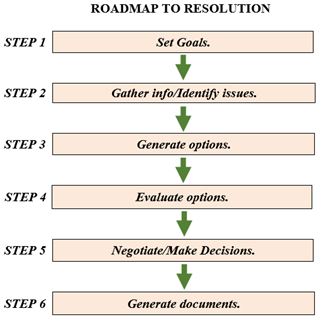
RoadmapOften when we decide to do something of significance, like go on vacation, obtain a college degree, search for a new job, or save for a future purchase we develop a plan.  If you are serious about the task set before you, you will develop a written plan to keep you on track and measure your progress. Getting unmarried, as I now refer to divorce, should be no different. In fact, if you choose to use a collaborative divorce process, we utilize a written document called “Roadmap to Resolution.” I have found the use of this Roadmap extends beyond divorce planning.  I use it as a general problem-solving model. The Roadmap has 6 essential steps.
  1. Set Goals  The four basic sets of big picture goals include: Relationship goals between you and your soon to be ex-spouse Goals related to your children regardless of their ages Financial goals as to how you and your spouse would like your future financial lives to look so you both can have the greatest sense of financial well being with the resources you have Process goals as to how you and your spouse would like the process to work for you
  2. Gather Information and Identify Issues This includes gathering all financial documents and other relevant information that will be necessary to itemize all assets, liabilities, income, estimated reasonable and necessary living expenses, and property received as a gift, inherited, or acquired before the marriage.  All of this information is documented in your final divorce decree.  If you have children, this also includes information about your children their needs and special activities and costs associated with each one.
  3. Generate Options This step is when the collaborative team including attorneys, coach, child specialist,  financial neutral, and clients brainstorm to identify any options that come to mind regardless of how silly or unpleasant those options might sound initially.  The key is to write down as many options as possible without anyone commenting or trying to evaluate any stated options.
  4. Evaluate Options Here the clients indentify the options they would like to evaluate and consider.  It is at this stage clients can fully explore the pros and cons of each of the options listed and prioritize them.
  5. Negotiate/Make Decisions After fully evaluating any options clients are able to negotiate and make decisions they both can live with.
  6. Generate Documents Once all necessary decisions are made, the attorneys go to work to document agreements by preparing a draft decree for each spouse to review and ultimately sign.
The model flows both ways; meaning if you are in step 5 negotiate/make decisions, another option may present itself, creating a need for further evaluation and new negotiation and decision making. The “Roadmap to Resolution” model provides the framework for helping spouses work through a collaborative divorce and ultimately reach agreements on all relevant issues. By using the “Roadmap to Resolution, the collaborative team process, has literally helped thousands of couples across the country and around the world end their marriage but save their family. Choose your process wisely.
126428878-four-frowning-male-and-female-gingerbread-gettyimagesWhether this is your first holiday season post-divorce, or you’ve been through several, it’s likely one of the hardest time of the year for you. Navigating the holidays after a divorce is much like navigating the holidays after the loss of a loved one. You likely are mourning the loss of making new memories and how the holidays “should” look like as a family. It is perfectly normal (and healthy) to have those feelings of dread and angst towards the upcoming holiday season. With the holidays comes the pressure to feel that “it’s the most wonderful time of the year,” when in fact through your grief you might be thinking that it’s the least wonderful time of the year. If this is your first holiday season post-divorce, you probably have a lot of questions going through your head. What will you do? Where will you go? How will you celebrate? How can you even thing of celebrating during this time of grief? Where will the kids be? What if you don’t want to be around people? These questions are completely normal as the holiday season presents itself with some unique challenges to navigate through. It might be difficult to consider your own needs, but now is the time to think about yourself, and what is healthy for YOU. For some that might mean jumping in neck deep into the Thanksgiving/Christmas/Hanukkah/Kwanzaa festivities and keeping yourself too busy to think, and for others booking a trip to Mexico and forgetting the holidays even exist might feel like a better option. It’s important to remember that you do not have to give into the pressure of the holidays. Give yourself permission to organize your holiday season is the best way that works for you. You might be thinking “what if I don’t know what’s best for me?” Or “what about the kids?” If you don’t have children it might be easy to skate through the holidays without decorating a tree or baking cookies, but as parents there is always extra pressure to make sure that the holidays still go on for the kids. Create new traditions. Don’t be afraid to break the mold. What may have been all they’ve ever known for the holidays does not define the holidays. All your children need is your love and attention. 20 years from now they won’t remember the year they didn’t have the annual 12 foot Christmas tree, but they will remember laughing through the woods as you tried to find the worst looking Charlie Brown tree you could find! Wishing you luck, laughter, and whatever it takes for you to steer through the holidays this season. May you find your new normal someday, but until then, simply doing what you can to get through is enough too.
170153517-definition-forgive-gettyimages“Many promising reconciliations have broken down because, while both parties came prepared to forgive, neither party came prepared to be forgiven.”  – Charles Williams, British author and translator I recently came across this quote about forgiveness and reconciliation and it reminded me of the collaborative divorce process. I am a collaborative attorney.  I often see couples enter into the divorce process with ideas about forgiveness.  I often see clients come into the divorce process hoping to end the anger or negative feelings. They may want to make things better for the sake of the children or to feel better themselves, whatever the reason, forgiveness can be one of the most impactful elements of divorce. To forgive is to stop feeling anger toward someone who has done something wrong or to stop blaming someone.  In divorce, forgiveness may revolve around infidelity or poor financial management or lessening attraction for another. Emotionally clients often prepare to own their own feelings. They may have considered the benefits of forgiving the other and moving forward in a more positive manner. Like the quote above implies, it is often easier to think about forgiving someone else. When someone is forgiven himself or herself, however, it may be tougher to accept. The selflessness of the other during the challenging process of divorce can sometimes be overwhelming. Genuine forgiveness may be unexpected. It can lead to breakthrough moments and opportunities to dig deeper to find more compassionate and amicable resolutions. Forgiveness and divorce are intertwined. The collaborative divorce process is designed and supported to allow the greatest opportunities for forgiveness and peacemaking.        
In part I of keep more of your money in your family; choosing your process wisely I wrote about the well known traditional litigated court based divorce process and mediation. In this issue, I will cover Collaborative Divorce. Collaborative divorce is an option you and your spouse should thoroughly explore before making any choice about divorce process. It is my belief that you and your spouse should first decide upon process before you ever hire an attorney. You can then match the right attorney to the right process. Just because they are, a divorce attorney does not mean they can be effective and efficient in all processes. In a collaborative divorce , a collaboratively trained attorney through the entire process represents each spouse. A financial specialist helps couples sort out their financial issues including gathering all the financial data necessary for the divorce decree and presenting it to their respective attorneys in a format that helps attorneys review the numbers more efficiently. Contrast this with you and your spouse providing each of your attorneys the financial data, the two attorneys talking together about the financial data and then going back to you their client to discuss those conversations then going back again to the other attorney to discuss. Let me ask you on just this one basic step in the financial process, do you think you would keep more of your money in your family? Do you want to be paying two attorneys to do this financial data gathering or would you prefer to pay one financial specialist? A financial specialist is the one person who is in the best position to help you keep more of your financial resources in your family throughout the divorce process. They can save you taxes, come up with some creative options, and other ideas that allow both you and your spouse to create the best financial outcome for each of you given your existing resources. In any divorce with minor children, a parenting plan is created and documented. In the collaborative divorce process, this is usually completed with a child specialist. This person helps parents articulate and document a well thought out plan to co-parent their children. The child specialist meets with the parents and often times meets with the children separately and then with everyone together. This level of attention to the family well-being is not found in other processes. You can of course work with two attorneys or a mediator to come up with a parenting time schedule and perhaps another piece or two of a well thought out plan. What you are not likely to get is a complete parenting plan that increases the likelihood of your children successfully navigating your divorce with you and your spouse. Also available in the collaborative divorce process is a neutral divorce coach. The divorce coach helps spouses communicate effectively during the divorce process and come up with a plan for post divorce communication and relationship. This can lower conflict, which can decrease costs. If emotions run high at some point during the divorce process, a coach acts to ground you in the areas that are important to you. This enables both you and your spouse, to effectively communicate your needs, interests, and concerns all necessary to produce the higher-level outcome intended to last for a long time. It is interesting to me that I often hear people say they are concerned about divorce costs when learning about collaborative divorce. Yet the collaborative divorce process minimizes attorney involvement since much of the work with the neutral financial specialist, neutral child specialist, and neutral divorce coach is completed without attorneys present. Attorneys usually are the highest paid professionals in any divorce process and most are not trained in financial issues, child and family systems, or other family relationship dynamics. What attorneys are trained in is the law. So imagine yourself utilizing a divorce process providing you with a menu of professional resources to help you and your family work with specialists in their respective fields and yet always have access to your own attorney who will be your advocate.   Of the three processes discussed in this two issue article which do you think will allow you to keep more of your money in your family, traditional litigation, mediation, or collaborative divorce? Remember to help you keep more of your money in your family choose your process wisely. In Part II of Keep More of Your Money in Your Family, I will write about choosing your attorney wisely.
157494477-redheaded-girl-in-cloud-of-leaves-gettyimagesLooking for some Twin Cities fun on a budget? Going from a duel income to a single income is not only difficult, but can bring on many emotions, especially if it leaves you feeling inadequate with providing for your children. There are so many low and no cost options out there that you don’t have to feel your children are missing out if you are on a single parent budget. Here are some of our favorites:
  • Como Zoo (free)
  • Minneapolis Sculpture Garden (free)
  • Walker Art Center (free admission Thursdays from 5-9pm)
  • Minnesota History Center (free admission Tuesdays from 5-8pm)
  • Fishing at many local community piers and parks (free)
  • Minnehaha Falls (free)
  • Three Rivers Parks District: Elm Creek Park Reserve, Lowery nature Center, Minnetonka Regional Park, etc. (free admission and many free activities and play equipment). Tip: make a list for a scavenger hunt before you go, kids LOVE scavenger hunts!
  • Minnesota Children’s Museum (free admission the 3rd Sunday of each month)
  • Outdoor concerts in the summer: Minneapolis Music in the Parks and St. Paul Music in the Parks, as well as many suburban concert series (free)
  • Movies in the Park in Summer: many area options (free)
  • Minnesota Landscape Arboretum (free admission every third Thursday of the month after 4:30 pm April through October)
  • Farmer’s Markets: many area options, check your city and surrounding areas for dates and times. Tip: If you go close to the end of the day many vendors may have reduced their prices or are willing to negotiate on fresh produce. (free admission)
  • Bike or walk the area trails. We are very blessed with many quality area trails like the Luce Line, Dakota Rail Regional Trail, etc. Tip: Another great place for a scavenger hunt!
  • Local beaches in the summer – We are in the land of 10,000 lakes, there are so many options for free swimming and sand castle fun!
  • Local art fairs, craft fairs, car shows, etc. Admission is typically free and it is so fun to walk around and look at everything.
Also be sure to check out local discount websites such a www.SaveOn.com, www.Groupon.com, and www.LivingSocial.com, where you can find deep discounts on local amusement parks, museums, the arboretum, restaurants, and more!
169749111-divorce-gettyimages“Many promising reconciliations have broken down because, while both parties came prepared to forgive, neither party came prepared to be forgiven.”  – Charles Williams, British author and translator I recently came across this quote about forgiveness and reconciliation and it reminded me of the collaborative divorce process. I am a collaborative attorney.  I often see couples enter into the divorce process with ideas about forgiveness.  I often see clients come into the divorce process hoping to end the anger or negative feelings. They may want to make things better for the sake of the children or to feel better themselves, whatever the reason, forgiveness can be one of the most impactful elements of divorce. To forgive is to stop feeling anger toward someone who has done something wrong or to stop blaming someone.  In divorce, forgiveness may revolve around infidelity or poor financial management or lessening attraction for another. Emotionally clients often prepare to own their own feelings. They may have considered the benefits of forgiving the other and moving forward in a more positive manner. Like the quote above implies, it is often easier to think about forgiving someone else. When someone is forgiven himself or herself, however, it may be tougher to accept. The selflessness of the other during the challenging process of divorce can sometimes be overwhelming. Genuine forgiveness may be unexpected. It can lead to breakthrough moments and opportunities to dig deeper to find more compassionate and amicable resolutions. Forgiveness and divorce are intertwined. The collaborative divorce process is designed and supported to allow the greatest opportunities for forgiveness and peacemaking.
Your divorce probably has you feeling like everything is beyond your control. Now imagine the lack of control your children are feeling. Yesterday they had a family with two parents living under the same roof, and today their family life as they knew it is torn apart. Your children may not have any idea how things got to this point, much less have the ability to change things. While it is seemingly impossible to feel in control right now, as a parent it is your role to support your children and help them to cope with the stress of the divorce. Focusing on these four components should help to lessen the stress on your children: patience, reassurance, structure, and stability. Patience. Have the patience to answer your child’s never ending questions they may have about the divorce. Offer them a listening ear and time to vent. Patience is tricky, especially when you are going through such a stressful time in your life. This is why it becomes so incredibly important for you to take care of yourself so that you can be the best parent you can be. Do whatever you can not to take your own stress out on your children. Even if it’s as simple as locking yourself in the bathroom for 5 minutes to cool off – do it. Reassurance. Reassure your children that they are still loved by both parents, and that they did not cause this. Reassure them that it is ok to have fun and enjoy their time with each parent by not acting jealous or getting upset. Do not put your child in a situation where they are forced to pick a side, which will only cause them more stress. Reassure them that you will get through this together, and that this is not the end of their family, but rather the beginning of a different type of family for them. Structure. By providing routines kids can rely on, you remind your children they can count on you for stability, structure, and care. This is where parenting plans come into play and are so important to maintaining structure. A toddler may not know what day of the week it is, but something as simple as a color coded weekly calendar showing them what days they go to moms house at what days they go to dads house can help them to understand their routine. A preteen or teen may benefit more from an electronic calendar, where they know exactly who is picking them up from school and activities each day. Find what works best for maintaining structure in your family and stick to it. Stability. It is important to maintain structure in order to provide stability for your children. If one parent has bailed on picking up the kids for the past two weeks, that child no longer has the stability in their life to help them cope with the stress of divorce. Parents in this situation will often stop telling their children when the other parent is going to pick them up because they hate to see them get disappointed. When this happens the parenting plan needs to be addressed and reevaluated. Not only is it stressful on the parent when the other doesn’t follow through, but it is incredibly stressful on children. All of these points go hand in hand with one another. The more stability and structure you have, the more reassured your child will be. Divorce may be uncharted territory, but you can successfully navigate this unsettling time—and help your kids emerge from it feeling loved, confident, and strong.
561097939-man-inserting-coin-into-piggy-bank-gettyimagesGetting married sometimes can be expensive if you let it. Getting unmarried can be even more expensive if you and or your spouse allows it to get that way. In divorce, emotions are high and often contribute to higher levels of conflict. Conflict is expensive. Many divorcing couples want to know how they can keep more of their financial resources between themselves and in their family. After all the more that goes to pay for divorce costs means less for each spouse and for their children if they have children. In this upcoming series, I will write about some tips on how to keep more of your financial resources in your family. Here is the first tip:
  1. Choose your process wisely. Study your options and know what you and your spouse want. I ask divorcing clients what would need to happen in your divorce so you could look back three years from now and say this was a successful transition for your family and you. Paint that picture for me. Be honest with yourself.
    1. If you want a knock down drag out divorce, you know the Katie bar the door kind or I will show him/her, or I will make him/her pay, a more traditional litigation process certainly fits that bill. Moreover, that bill will be very expensive. On top of that, someone else, a judge, will be making decisions for you since you and your spouse are not able to reach agreements on your own.   If you think, you are going to win and be the victor you have already lost because there are no winners in divorce. Most judges tend to think the best outcome if they have to decide your divorce is one when both spouses equally share the pain and both spouses are somewhat dissatisfied.
    2. You may consider mediation. Most people have heard about mediation. Mediation can be less expensive than a traditional court based process.   Mediators however, are not able to provide legal advice. This is true even if the mediator is an attorney. Sometimes couples choose to have their own lawyers present at mediation sessions to overcome the no legal advice dilemma. Mediators, even if they are an attorney are not able to draft/prepare final divorce decree documents. If a mediator helps you reach agreements, you, and your spouse take those agreements to an attorney to draft the final documents and that attorney can only represent one of you, not both spouses. I always encourage my divorcing clients to each have their own attorney when reviewing any final documents resulting from mediation. You may run into one or both of the attorneys encouraging you not to accept the mediated agreements or parts of the agreements. In my practice, I recommend to clients attorneys that I know and have worked with, are settlement oriented, and not inclined to escalate conflict in an already mediated agreement. That is not to say there will not be some tweaks here and there because there always are and for good reason.
In part II of Keep More of Your Money in Family, I will talk about collaborative divorce, the professionals involved, and how it can help you keep more of your money. Stay tuned more to come.
A Puzzled ScratchWhen a couple decides to get a divorce, they have options. The continuum of divorce processes range from a kitchen table or “pro se” process where the parties work on their own all the way to a full litigation in front of a court.  All of the following processes result in a final divorce and resolution of all issues. Each process is unique and may work for you. Pro Se/Kitchen Table What is it: Parties work out resolutions all on their own; may draft up the papers on their own or fill out online papers directly with the Court. Pros/Cons: Can be quick and nearly free, but requires an ability to work together. Neither party received legal advice. Mediation What is it: Parties work out resolutions with a neutral third-arty mediator; lawyers may or may not be involved.  Once resolutions are reached, the parties may draft up the papers on their own or hire attorneys to provide legal advice and draft up the divorce papers. Pros/Cons: Can be quick, but requires an ability to make decisions for yourself, sometimes without legal advice. Collaborative Law What is it: Parties  each have an attorney and work out resolutions in a settlement-focused, out-of-court process; other specialists can be involved, such as a financial specialist, child specialist or coach. Pros/Cons: Thorough process that can address all issues with legal advice and other specialists, but requires ability to make decisions in one’s own best interest. Litigation/Court Process What is it: Parties present their case to a third-party decision-maker for adjudication of the issues. Pros/Cons: Parties have little control over the pacing of the process; but attorneys are typically involved throughout. Once you learn about the processes, you should meet with a professional to learn which process is best for you.