In part I of
keep more of your money in your family; choosing your process wisely I wrote about the well known traditional litigated court based divorce process and mediation. In this issue, I will cover Collaborative Divorce.
Collaborative divorce is an option you and your spouse should thoroughly explore before making any choice about divorce process. It is my belief that you and your spouse should first decide upon process before you ever hire an attorney. You can then match the right attorney to the right process. Just because they are, a divorce attorney does not mean they can be effective and efficient in all processes. In a
collaborative divorce , a collaboratively trained attorney through the entire process represents each spouse.
A financial specialist helps couples sort out their financial issues including gathering all the financial data necessary for the divorce decree and presenting it to their respective attorneys in a format that helps attorneys review the numbers more efficiently. Contrast this with you and your spouse providing each of your attorneys the financial data, the two attorneys talking together about the financial data and then going back to you their client to discuss those conversations then going back again to the other attorney to discuss. Let me ask you on just this one basic step in the financial process, do you think you would keep more of your money in your family? Do you want to be paying two attorneys to do this financial data gathering or would you prefer to pay one financial specialist? A financial specialist is the one person who is in the best position to help you keep more of your financial resources in your family throughout the divorce process. They can save you taxes, come up with some creative options, and other ideas that allow both you and your spouse to create the best financial outcome for each of you given your existing resources.
In any divorce with minor children, a parenting plan is created and documented. In the collaborative divorce process, this is usually completed with a
child specialist. This person helps parents articulate and document a well thought out plan to co-parent their children. The child specialist meets with the parents and often times meets with the children separately and then with everyone together. This level of attention to the family well-being is not found in other processes. You can of course work with two attorneys or a mediator to come up with a parenting time schedule and perhaps another piece or two of a well thought out plan. What you are not likely to get is a complete parenting plan that increases the likelihood of your children successfully navigating your divorce with you and your spouse.
Also available in the collaborative divorce process is a neutral divorce coach. The divorce coach helps spouses communicate effectively during the divorce process and come up with a plan for post divorce communication and relationship. This can lower conflict, which can decrease costs. If emotions run high at some point during the divorce process, a coach acts to ground you in the areas that are important to you. This enables both you and your spouse, to effectively communicate your needs, interests, and concerns all necessary to produce the higher-level outcome intended to last for a long time.
It is interesting to me that I often hear people say they are concerned about divorce costs when learning about collaborative divorce. Yet the collaborative divorce process minimizes attorney involvement since much of the work with the neutral financial specialist, neutral child specialist, and neutral divorce coach is completed without attorneys present. Attorneys usually are the highest paid professionals in any divorce process and most are not trained in financial issues, child and family systems, or other family relationship dynamics. What attorneys are trained in is the law. So imagine yourself utilizing a divorce process providing you with a menu of professional resources to help you and your family work with specialists in their respective fields and yet always have access to your own attorney who will be your advocate. Of the three processes discussed in this two issue article which do you think will allow you to keep more of your money in your family, traditional litigation, mediation, or collaborative divorce?
Remember to help you keep more of your money in your family choose your process wisely. In Part II of Keep More of Your Money in Your Family, I will write about choosing your attorney wisely.


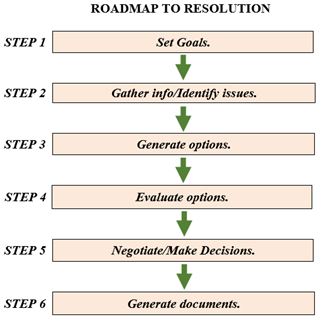 Often when we decide to do something of significance, like go on vacation, obtain a college degree, search for a new job, or save for a future purchase we develop a plan. If you are serious about the task set before you, you will develop a written plan to keep you on track and measure your progress.
Getting unmarried, as I now refer to divorce, should be no different. In fact, if you choose to use a collaborative divorce process, we utilize a written document called “Roadmap to Resolution.” I have found the use of this Roadmap extends beyond divorce planning. I use it as a general problem-solving model. The Roadmap has 6 essential steps.
Often when we decide to do something of significance, like go on vacation, obtain a college degree, search for a new job, or save for a future purchase we develop a plan. If you are serious about the task set before you, you will develop a written plan to keep you on track and measure your progress.
Getting unmarried, as I now refer to divorce, should be no different. In fact, if you choose to use a collaborative divorce process, we utilize a written document called “Roadmap to Resolution.” I have found the use of this Roadmap extends beyond divorce planning. I use it as a general problem-solving model. The Roadmap has 6 essential steps.
 Vacations are a common part of family life. Some families like to camp or take close-to-home trips to a local hotel or amusement location. Other families have vacation traditions, such as family reunions or a favorite locales that they visit year after year. And others may like to spend freely and take extravagant vacations.
It is common to be concerned about vacations in divorce. When one, nuclear family becomes a bi-nuclear family with two home bases, it may seem like a foregone conclusion that vacations will need to end. While things certainly need to change, in a
Vacations are a common part of family life. Some families like to camp or take close-to-home trips to a local hotel or amusement location. Other families have vacation traditions, such as family reunions or a favorite locales that they visit year after year. And others may like to spend freely and take extravagant vacations.
It is common to be concerned about vacations in divorce. When one, nuclear family becomes a bi-nuclear family with two home bases, it may seem like a foregone conclusion that vacations will need to end. While things certainly need to change, in a 

 A strategy used by some divorcing spouses and their attorneys is to threaten that they will take the other spouse to court. Threatening court is a negotiation strategy in an effort to get the other side to give up or significantly compromise their position(s).
When attorneys use this tactic, they often will prepare for a trial. The trial preparation ends up being extremely expensive and emotionally exhausting for the involved spouses. Often a hatred for the other spouse develops because of trials and/or the threatened use of court.
The reality is a small fraction of divorces end up in trial. The overwhelming reason those cases do end up in trial is because spouses and their attorneys refuse to negotiate. Sometimes a spouse will tell their attorney to go for the throat or they say I want to make him/her pay. It is the divorcing spouses and unfortunately their children, if any, that end up paying the price financially and emotionally. Seeking revenge does not have a place in any divorce process and accompanied by an unwillingness to negotiate in good faith sets up a strategy to fail.
A strategy used by some divorcing spouses and their attorneys is to threaten that they will take the other spouse to court. Threatening court is a negotiation strategy in an effort to get the other side to give up or significantly compromise their position(s).
When attorneys use this tactic, they often will prepare for a trial. The trial preparation ends up being extremely expensive and emotionally exhausting for the involved spouses. Often a hatred for the other spouse develops because of trials and/or the threatened use of court.
The reality is a small fraction of divorces end up in trial. The overwhelming reason those cases do end up in trial is because spouses and their attorneys refuse to negotiate. Sometimes a spouse will tell their attorney to go for the throat or they say I want to make him/her pay. It is the divorcing spouses and unfortunately their children, if any, that end up paying the price financially and emotionally. Seeking revenge does not have a place in any divorce process and accompanied by an unwillingness to negotiate in good faith sets up a strategy to fail.
 Understanding the difference between interests and positions could make all of the difference in helping you negotiate a better outcome in your divorce.
Position-Based Bargaining: Most people have a tendency to negotiate by arguing in favor of their positions. In divorce, this type of “position-based” bargaining can actually make it more difficult to get what you want. Once you and your spouse become locked into positions, the need to defend those positions can lead to a lengthy and expensive divorce. Often position based negotiations come to an end only after both parties have reached a point of physical and emotional exhaustion only to reach a “meet in the middle” agreement. One of the many problems with meeting in “the middle” is that the best solutions may have existed outside of either position. Creative negotiation that avoid positions and focus on interests can lead to outcomes that are better for both parties.
Interest-Based Bargaining: In divorce, couples start by determining their interests and look for true “win/win” scenarios. In order to appreciate how interest-based bargaining works, it is important to understand the difference between positions and interests.
Positions are narrow; “win/lose” proposals can only be satisfied in one way. For example, statements such as “I want Sole custody” or “I need $5,000 per month in support” or “I must have the house” represent positions that require the other person to “lose” in order for you to win. On the other hand, “interests” (sometimes called goals) focus on big picture desires that can be satisfied in many ways. Statements such as “I want our children to be kept out of the conflict” or “I want financial stability for both homes” or “I want us to be able to communicate better in our co-parenting” are requests to have an important interest met.
One of the advantages of focusing on big-picture interests is that you and your spouse are likely to have many of these interests in common. Therefore, although working on the details of how these interests can be met will still require some problem solving skills (and some bargaining) the negotiation becomes easier because you are both working toward these important common goals.
Interest-based bargaining is a skill that needs to be developed over time. Divorce negotiations are usually improved when the professionals involved have significant training and experience in this method so that they can teach these skills to their clients. Most mediators and Collaborative professionals have training and experience in interest based bargaining. To locate a professional who understands this method to interview and to learn more about interest based divorce negotiation go to
Understanding the difference between interests and positions could make all of the difference in helping you negotiate a better outcome in your divorce.
Position-Based Bargaining: Most people have a tendency to negotiate by arguing in favor of their positions. In divorce, this type of “position-based” bargaining can actually make it more difficult to get what you want. Once you and your spouse become locked into positions, the need to defend those positions can lead to a lengthy and expensive divorce. Often position based negotiations come to an end only after both parties have reached a point of physical and emotional exhaustion only to reach a “meet in the middle” agreement. One of the many problems with meeting in “the middle” is that the best solutions may have existed outside of either position. Creative negotiation that avoid positions and focus on interests can lead to outcomes that are better for both parties.
Interest-Based Bargaining: In divorce, couples start by determining their interests and look for true “win/win” scenarios. In order to appreciate how interest-based bargaining works, it is important to understand the difference between positions and interests.
Positions are narrow; “win/lose” proposals can only be satisfied in one way. For example, statements such as “I want Sole custody” or “I need $5,000 per month in support” or “I must have the house” represent positions that require the other person to “lose” in order for you to win. On the other hand, “interests” (sometimes called goals) focus on big picture desires that can be satisfied in many ways. Statements such as “I want our children to be kept out of the conflict” or “I want financial stability for both homes” or “I want us to be able to communicate better in our co-parenting” are requests to have an important interest met.
One of the advantages of focusing on big-picture interests is that you and your spouse are likely to have many of these interests in common. Therefore, although working on the details of how these interests can be met will still require some problem solving skills (and some bargaining) the negotiation becomes easier because you are both working toward these important common goals.
Interest-based bargaining is a skill that needs to be developed over time. Divorce negotiations are usually improved when the professionals involved have significant training and experience in this method so that they can teach these skills to their clients. Most mediators and Collaborative professionals have training and experience in interest based bargaining. To locate a professional who understands this method to interview and to learn more about interest based divorce negotiation go to