82087964-start-on-january-1-gettyimagesAs 2016 begins, many of us come up with resolutions for the coming year. Some people hope to exercise more, spend more time as a family or plan a vacation. For families who have divorced, the new year often symbolizes a new beginning.  It is a time to establish a new norm. As a collaborative attorney, I often help guide families through divorce in respectful and supportive ways. I often hear from clients that they have goals and resolutions for a new year. Here are three common resolutions for families of divorce and ways all families can incorporate these values in their lives:
  1. Establish financial independence and security. Entering a new year is a time when finances are now truly separate – with no tax connections.  Be mindful of what you spend.  Track your expenses and see how they match up against your projected budgets and income.  Get a financial planner or, on your own, map out your financial goals for the year, including personal savings, retirement, and investment management.
  2. Embrace co-parenting. Children thrive with routine and care.  They love to be listened to and enjoy one-on-one time with both parents.  They also sense stress and tension.  As you establish routines and the children spend time with both parents, remember to treat the other parent with compassion as well. Avoid fighting in front of the children and support the time that they spend in both homes. Also learn to enjoy your off-duty time.  When you don’t have parenting duties can be a great time to focus on yourself and prepare for your next parenting day.
  3. Take care of yourself.  As parents, workers, and functioning members in society, we often spend our tie focused on others.  We take care of the children and our work obligations, but we often forget our own self-care.  Use the new year to establish work-out routines or start exploring a new hobby.  It is never too late to start improving yourself and the new year is a perfect time to make that effort.
Many collaborative law attorneys offer a free consult – 30-60 minutes to meet your potential new attorney and get some questions answered. The consult serves two main purposes: learn about your options and get to know your potential attorney. Until you have hired an attorney, you do not have confidentiality or a legal relationship with the attorney. The consulting attorney cannot give you legal advice or answer legal questions with certainty during this first meeting. The consulting attorney can talk to you about the processes available to you – litigation, collaborative law, or mediation. The consulting attorney can tell you the main legal issues that need to be decided during a case – such as child custody, parenting time, spousal maintenance, or property division. Because the consulting attorney does not have a client relationship, you and your spouse could meet with the attorney together. This is often a good way for you both to hear information together about the process. When you receive the same message, you often feel less adversarial and more like you are both seeking a guide for the process. Indeed, one of the most important aspects of a consult, is the opportunity for you to meet a potential attorney and see if you will be comfortable working with them. Your attorney is your guide. You may cry or express anger in front of this person – you need to feel comfortable doing so. In addition to legal adeptness and zealous advocacy, you also must be comfortable and trust your attorney. This is perhaps the most important element of the relationship.
CaptureAn entry of divorce is a big step in the process. However, there is often a lot of follow-up needed to make everything final.  Here are some of the things that need to be addressed post-divorce:
  • Certified copies.  You should obtain a certified copy (official) of the divorce decree for your records.
  • Notice of Entry. Your attorney will draft a Notice of Entry to confirm everyone is aware of the entry and final outcome.
  • Assets should be divided.  If you agreed to split bank accounts, pay off debt, or pay an equalizer to finalize a property settlement, these things should be divided and paid off.
  • Vehicle titles can be transferred.  You can sign over the title on vehicles as outlined in your agreement.  This can usually be finalized without attorney work.
  • Real estate title transfer. A quit claim deed or order from the court (called a Summary Real Estate Disposition Judgment) can be recorded with the county real estate office to transfer title in your real estate.
  • Retirement division.  Some retirement accounts can be divided with notification from the clients.  Other accounts, specifically 401k’s, 403b’s and pensions usually need an order from the court to divide.  This order is called a Qualified Domestic Relations Order (QDRO).  A lawyer usually drafts this order.
There can sometimes be a lot of follow-up to a divorce.  A collaborative attorney can help you through the process and help make sure all follow-up items are completed.
The viral video of a father reaching out to his ex-Wife’s new husband, his daughter’s stepdad, and asking him to join him and walk their daughter down the aisle has had a huge impact. It has been shared millions of times. I have noticed a number of my social media friends and colleagues sharing this video. The comments seem to fall into two categories.  First, for divorced parents or children of divorce, many look at this video as a painful reminder of how horrible divorce can be. Many have memories of the strain and tension between their parents after divorce or cannot imagine ever having a connection with an exes new partner. Others see this video as recognition of the new face of divorce.  Divorce can be healthy and can lead to new families that are, in many ways, stronger and healthier than they were before.  Bonus parents or step parents can be wonderful additions to a child’s life. I see these stories all the time.  I am a collaborative attorney dedicated to helping families divorce in better ways.  I hear stories of clients all the time having better relationships with their co-parent after a divorce. Like this mother who wrote a letter to her daughter’s future step-mother or this lovely New York Times article about two divorced parents vacationing together — this can be the new face of divorce. The collaborative law process allows for creative and respectful outcomes – it keeps the children at the very center of everything and helps families thrive. Social media is drawn to thee stories because people crave these types of outcomes and want a better future after divorce.  Collaborative law provides these types of resolutions and more and more peaceful extended families.
185241979-african-american-businesswoman-on-white-gettyimages After choosing your process wisely, discussed in my two previous blogs part 1 and part II, the next step is to choose your attorney wisely. I believe this is something to approach with significant thought about your goals, careful consideration about the process you want to follow and your own beliefs and values. How do your goals and process choices affect the choice of an attorney? When I mention goals, I am not just talking about your goals. The goals of your spouse are just as important. It is important to remember you are not in this divorce alone, your spouse is also present. You both have anxiety, fears, and unanswered questions about how is this all going to turn out. Please do not forget that attorneys selected by each of you will have their own goals. Their goals may not necessarily be in alignment with your own. Ideally, you and your spouse are able to discuss your goals together. You both may have some shared goals although in the throes of divorce this may be the furthest thing from both of your minds. Each of you will have some different individual goals. I would suggest to the extent possible working together with your spouse to identify these goals as they relate to children if any, relationship and communication with each other and extended family during and post divorce, financial security goals, and divorce process goals. Your ability to articulate and document these goals will in the end minimize conflict, and give you a roadmap if you will toward selecting attorneys. You will want to choose attorneys who are able to help you and your spouse achieve your goals. A collaborative divorce attorney once wrote about asking some straight to the heart kinds of questions when interviewing any divorce attorney. A question like, How concerned are you about what my spouse wants out of this divorce? This is a great question to ask any potential attorney you may be considering. How the attorney answers this question will give you loads of information about how this attorney will go about representing you.   If they say I think you should go after all you can get and then promise or insist they can get it for you, they are playing on your emotions and telling you what you want to hear. This attorney is probably more interested in putting on a show that will take money from your family resources instead of allowing you and your spouse to keep more of your money in your family where it belongs. This same collaborative attorney offered yet another question to ask a potential attorney. Ask if they believe a couple in conflict, going through divorce, can negotiate settlement outcomes without the use of threats or coercion to get what they want. If the attorney insists on using threats and coercion, they are likely not that skilled in interest based negotiations. Instead, they draw lines in the sand using threats and coercion. This leads to even more conflict and increasing costs meaning less money for you and your spouse to keep in your family. A settlement-oriented attorney will answer this question by explaining the differences between position-based negotiation and interest-based negotiation. One last question to ask a potential attorney is if they handle all parts of the divorce or do they often use outside experts such as a child specialist when children are involved or a financial specialist. The attorney who says they handle everything themselves may end up costing you and your spouse the most. This attorney is saying they are experts with children, finances, and legal matters. Rarely, if ever, is this the case. A child specialist financial specialist can bring great value to your divorce process. A parenting plan, which goes far beyond who stays overnight when and a financial plan to give both you and your spouse comfort in knowing you will be making the best use of your financial resources should give you and your spouse a degree of comfort and peace of mind. Besides that the cost of one child specialist and one experienced divorce financial specialist will be considerably less than attorney costs for dealing with these same issues. As you listen to the answers potential attorneys give when asked these three questions outlined in this post ask yourself: Is this attorney able to help me, and my spouse, work through our differences using the process we chose? Will this attorney seek to find outcomes that work not just for me but also for my spouse? Will this attorney choose to do all the work himself or herself or will they utilize experts in specific fields such as children, finances, and or relationship coaches when needed or helpful? Hearing the answers to these simple questions can help you decide whom to choose as an attorney. Choose wisely by being intentional, thoughtful, and in alignment with your goals, values, and beliefs. Doing so will allow you to keep more of your money in your family.

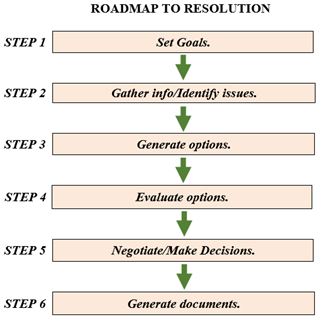
RoadmapOften when we decide to do something of significance, like go on vacation, obtain a college degree, search for a new job, or save for a future purchase we develop a plan.  If you are serious about the task set before you, you will develop a written plan to keep you on track and measure your progress. Getting unmarried, as I now refer to divorce, should be no different. In fact, if you choose to use a collaborative divorce process, we utilize a written document called “Roadmap to Resolution.” I have found the use of this Roadmap extends beyond divorce planning.  I use it as a general problem-solving model. The Roadmap has 6 essential steps.
  1. Set Goals  The four basic sets of big picture goals include: Relationship goals between you and your soon to be ex-spouse Goals related to your children regardless of their ages Financial goals as to how you and your spouse would like your future financial lives to look so you both can have the greatest sense of financial well being with the resources you have Process goals as to how you and your spouse would like the process to work for you
  2. Gather Information and Identify Issues This includes gathering all financial documents and other relevant information that will be necessary to itemize all assets, liabilities, income, estimated reasonable and necessary living expenses, and property received as a gift, inherited, or acquired before the marriage.  All of this information is documented in your final divorce decree.  If you have children, this also includes information about your children their needs and special activities and costs associated with each one.
  3. Generate Options This step is when the collaborative team including attorneys, coach, child specialist,  financial neutral, and clients brainstorm to identify any options that come to mind regardless of how silly or unpleasant those options might sound initially.  The key is to write down as many options as possible without anyone commenting or trying to evaluate any stated options.
  4. Evaluate Options Here the clients indentify the options they would like to evaluate and consider.  It is at this stage clients can fully explore the pros and cons of each of the options listed and prioritize them.
  5. Negotiate/Make Decisions After fully evaluating any options clients are able to negotiate and make decisions they both can live with.
  6. Generate Documents Once all necessary decisions are made, the attorneys go to work to document agreements by preparing a draft decree for each spouse to review and ultimately sign.
The model flows both ways; meaning if you are in step 5 negotiate/make decisions, another option may present itself, creating a need for further evaluation and new negotiation and decision making. The “Roadmap to Resolution” model provides the framework for helping spouses work through a collaborative divorce and ultimately reach agreements on all relevant issues. By using the “Roadmap to Resolution, the collaborative team process, has literally helped thousands of couples across the country and around the world end their marriage but save their family. Choose your process wisely.
520749655-man-in-mid-air-jumping-into-pool-during-gettyimagesVacations are a common part of family life.  Some families like to camp or take close-to-home trips to a local hotel or amusement location.  Other families have vacation traditions, such as family reunions or a favorite locales that they visit year after year.  And others may like to spend freely and take extravagant vacations. It is common to be concerned about vacations in divorce.  When one, nuclear family becomes a bi-nuclear family with two home bases, it may seem like a foregone conclusion that vacations will need to end.  While things certainly need to change, in a collaborative divorce, parents can work to develop a parenting plan that incorporates vacations and time away with the kids. It is common in parenting plans to provide each parent a certain number of days to take the children on vacation.  This time typically supersedes regular parenting plan – it is not a trade-off of days.  The parenting plan can outline further parameters on vacations, such as:

  • How much notice should be given for an upcoming trip.
  • Whether or not vacations can incorporate missing school.
  • Number of consecutive days allowed.
  • Communication parameters between the off-duty parent and the children while on vacation.
  • How far the children may be taken and what activities are permissible.
Parents often also work out the finances of a vacation in the divorce.  Sometimes vacation expenses are built into budgets and spousal maintenance obligations and other times each parent covers their own vacation expenses with the children. When parents work together on a parenting plan, they can come up with good resolutions about vacations and travel. A good collaborative professional can help start this process.  
170153517-definition-forgive-gettyimages“Many promising reconciliations have broken down because, while both parties came prepared to forgive, neither party came prepared to be forgiven.”  – Charles Williams, British author and translator I recently came across this quote about forgiveness and reconciliation and it reminded me of the collaborative divorce process. I am a collaborative attorney.  I often see couples enter into the divorce process with ideas about forgiveness.  I often see clients come into the divorce process hoping to end the anger or negative feelings. They may want to make things better for the sake of the children or to feel better themselves, whatever the reason, forgiveness can be one of the most impactful elements of divorce. To forgive is to stop feeling anger toward someone who has done something wrong or to stop blaming someone.  In divorce, forgiveness may revolve around infidelity or poor financial management or lessening attraction for another. Emotionally clients often prepare to own their own feelings. They may have considered the benefits of forgiving the other and moving forward in a more positive manner. Like the quote above implies, it is often easier to think about forgiving someone else. When someone is forgiven himself or herself, however, it may be tougher to accept. The selflessness of the other during the challenging process of divorce can sometimes be overwhelming. Genuine forgiveness may be unexpected. It can lead to breakthrough moments and opportunities to dig deeper to find more compassionate and amicable resolutions. Forgiveness and divorce are intertwined. The collaborative divorce process is designed and supported to allow the greatest opportunities for forgiveness and peacemaking.        
In part I of keep more of your money in your family; choosing your process wisely I wrote about the well known traditional litigated court based divorce process and mediation. In this issue, I will cover Collaborative Divorce. Collaborative divorce is an option you and your spouse should thoroughly explore before making any choice about divorce process. It is my belief that you and your spouse should first decide upon process before you ever hire an attorney. You can then match the right attorney to the right process. Just because they are, a divorce attorney does not mean they can be effective and efficient in all processes. In a collaborative divorce , a collaboratively trained attorney through the entire process represents each spouse. A financial specialist helps couples sort out their financial issues including gathering all the financial data necessary for the divorce decree and presenting it to their respective attorneys in a format that helps attorneys review the numbers more efficiently. Contrast this with you and your spouse providing each of your attorneys the financial data, the two attorneys talking together about the financial data and then going back to you their client to discuss those conversations then going back again to the other attorney to discuss. Let me ask you on just this one basic step in the financial process, do you think you would keep more of your money in your family? Do you want to be paying two attorneys to do this financial data gathering or would you prefer to pay one financial specialist? A financial specialist is the one person who is in the best position to help you keep more of your financial resources in your family throughout the divorce process. They can save you taxes, come up with some creative options, and other ideas that allow both you and your spouse to create the best financial outcome for each of you given your existing resources. In any divorce with minor children, a parenting plan is created and documented. In the collaborative divorce process, this is usually completed with a child specialist. This person helps parents articulate and document a well thought out plan to co-parent their children. The child specialist meets with the parents and often times meets with the children separately and then with everyone together. This level of attention to the family well-being is not found in other processes. You can of course work with two attorneys or a mediator to come up with a parenting time schedule and perhaps another piece or two of a well thought out plan. What you are not likely to get is a complete parenting plan that increases the likelihood of your children successfully navigating your divorce with you and your spouse. Also available in the collaborative divorce process is a neutral divorce coach. The divorce coach helps spouses communicate effectively during the divorce process and come up with a plan for post divorce communication and relationship. This can lower conflict, which can decrease costs. If emotions run high at some point during the divorce process, a coach acts to ground you in the areas that are important to you. This enables both you and your spouse, to effectively communicate your needs, interests, and concerns all necessary to produce the higher-level outcome intended to last for a long time. It is interesting to me that I often hear people say they are concerned about divorce costs when learning about collaborative divorce. Yet the collaborative divorce process minimizes attorney involvement since much of the work with the neutral financial specialist, neutral child specialist, and neutral divorce coach is completed without attorneys present. Attorneys usually are the highest paid professionals in any divorce process and most are not trained in financial issues, child and family systems, or other family relationship dynamics. What attorneys are trained in is the law. So imagine yourself utilizing a divorce process providing you with a menu of professional resources to help you and your family work with specialists in their respective fields and yet always have access to your own attorney who will be your advocate.   Of the three processes discussed in this two issue article which do you think will allow you to keep more of your money in your family, traditional litigation, mediation, or collaborative divorce? Remember to help you keep more of your money in your family choose your process wisely. In Part II of Keep More of Your Money in Your Family, I will write about choosing your attorney wisely.
561097939-man-inserting-coin-into-piggy-bank-gettyimagesGetting married sometimes can be expensive if you let it. Getting unmarried can be even more expensive if you and or your spouse allows it to get that way. In divorce, emotions are high and often contribute to higher levels of conflict. Conflict is expensive. Many divorcing couples want to know how they can keep more of their financial resources between themselves and in their family. After all the more that goes to pay for divorce costs means less for each spouse and for their children if they have children. In this upcoming series, I will write about some tips on how to keep more of your financial resources in your family. Here is the first tip:
  1. Choose your process wisely. Study your options and know what you and your spouse want. I ask divorcing clients what would need to happen in your divorce so you could look back three years from now and say this was a successful transition for your family and you. Paint that picture for me. Be honest with yourself.
    1. If you want a knock down drag out divorce, you know the Katie bar the door kind or I will show him/her, or I will make him/her pay, a more traditional litigation process certainly fits that bill. Moreover, that bill will be very expensive. On top of that, someone else, a judge, will be making decisions for you since you and your spouse are not able to reach agreements on your own.   If you think, you are going to win and be the victor you have already lost because there are no winners in divorce. Most judges tend to think the best outcome if they have to decide your divorce is one when both spouses equally share the pain and both spouses are somewhat dissatisfied.
    2. You may consider mediation. Most people have heard about mediation. Mediation can be less expensive than a traditional court based process.   Mediators however, are not able to provide legal advice. This is true even if the mediator is an attorney. Sometimes couples choose to have their own lawyers present at mediation sessions to overcome the no legal advice dilemma. Mediators, even if they are an attorney are not able to draft/prepare final divorce decree documents. If a mediator helps you reach agreements, you, and your spouse take those agreements to an attorney to draft the final documents and that attorney can only represent one of you, not both spouses. I always encourage my divorcing clients to each have their own attorney when reviewing any final documents resulting from mediation. You may run into one or both of the attorneys encouraging you not to accept the mediated agreements or parts of the agreements. In my practice, I recommend to clients attorneys that I know and have worked with, are settlement oriented, and not inclined to escalate conflict in an already mediated agreement. That is not to say there will not be some tweaks here and there because there always are and for good reason.
In part II of Keep More of Your Money in Family, I will talk about collaborative divorce, the professionals involved, and how it can help you keep more of your money. Stay tuned more to come.